- A practical small-home system for stag beetles and rhinoceros beetles
- Why small-space breeding needs a system
- 1. Divide the collection before buying containers
- 2. Use shelves as “care stations,” not storage
- 3. Choose containers by stage, not by species name
- 4. Build a label system that survives busy days
- 5. Track only the data that changes your decisions
- 6. Control temperature before chasing perfect humidity
- 7. Keep substrate work clean and scheduled
- 8. Prevent pests with routines, not chemicals
- 9. Create a weekly “five-minute route”
- 10. Know when not to expand
- A small-home setup can still be serious breeding
A practical small-home system for stag beetles and rhinoceros beetles
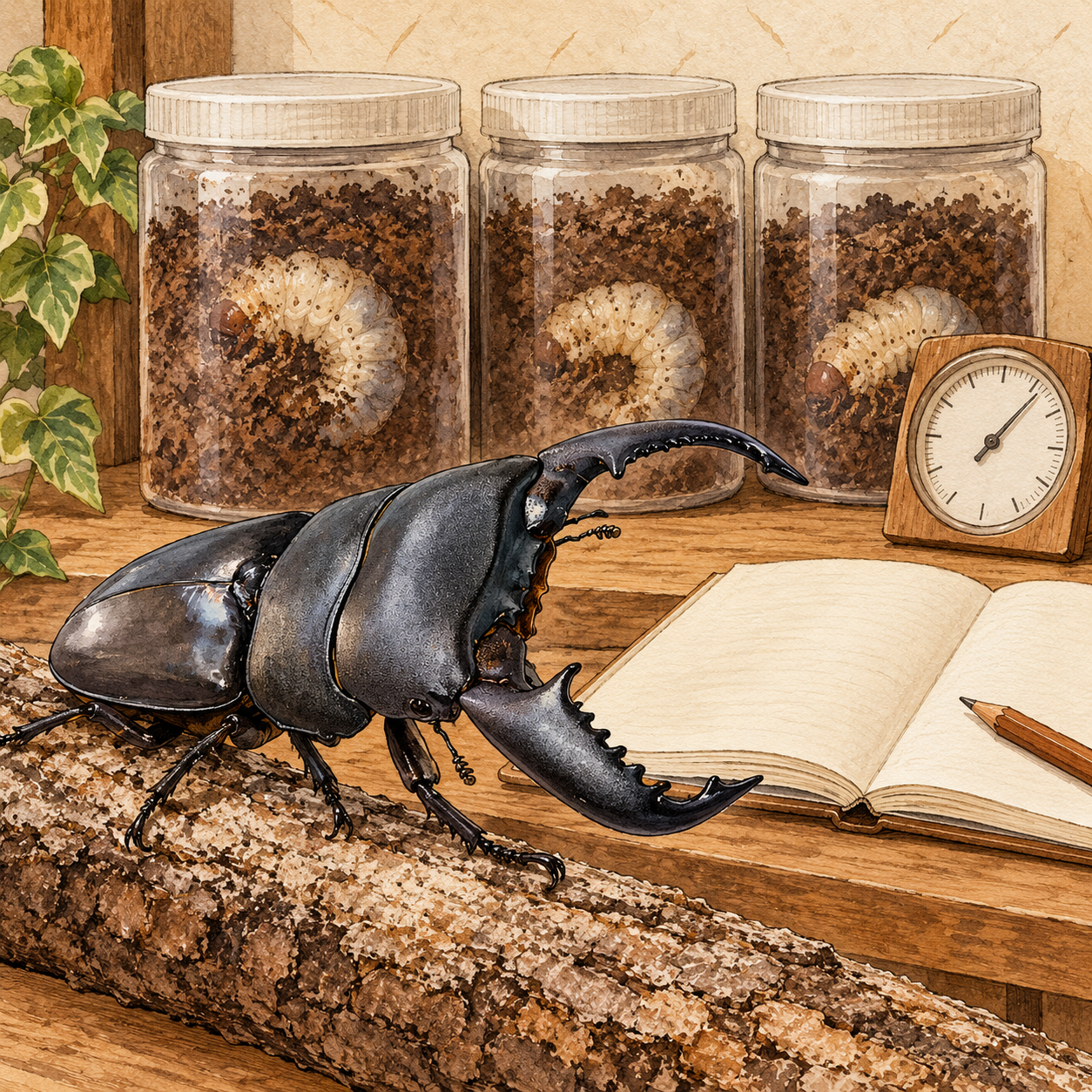
Keeping a single stag beetle or rhinoceros beetle is easy to imagine. Keeping dozens of larvae is different. Containers multiply, substrate has to be changed, temperatures rise quickly in summer, and one missed label can turn a carefully planned breeding project into guesswork.
In Japan, many hobbyists raise beetles in apartments, small houses, or one spare room—not in large dedicated breeding facilities. The answer is not simply buying more boxes. It is building a system that makes daily care simple and makes problems visible early.
This article explains the small-space approach used by Japanese keepers for stag beetles and rhinoceros beetles (often called kuwagata and kabutomushi in Japanese). It is not a guide to owning exactly 100 larvae. The point is to create a setup where every larva still receives proper care as the collection grows.
Important: Before buying, importing, exporting, or releasing any beetle, check the wildlife, invasive-species, and import rules where you live. Never release captive insects outdoors.
Why small-space breeding needs a system
Large collections usually do not fail because the keeper lacks enthusiasm. They fail when small tasks become too easy to postpone:
- a substrate change is forgotten;
- a container has no species or date label;
- a hot shelf is discovered only after larvae slow down;
- uneaten food attracts pests;
- new larvae are added without deciding where they will go.
The Japanese small-home method is built around one idea: make every container easy to identify, inspect, move, and clean. A simple, repeatable setup is safer than an impressive-looking one that is difficult to maintain.
1. Divide the collection before buying containers
The first mistake is organizing by container size alone. Organize the beetles by their care needs.
For a mixed collection, use separate zones for:
- Adult males – often need individual housing, especially stag beetles with strong jaws.
- Adult females and breeding pairs – temporary breeding containers only; do not leave incompatible adults together without supervision.
- Young larvae – more frequent checks and easier-to-change substrates.
- Large larvae or pupation-stage larvae – fewer disturbances and stable conditions.
- Quarantine / observation – a small, separate area for newly acquired beetles or animals with an unclear history.
This is more useful than placing all attractive adults on one shelf and all larvae somewhere else. Each zone has a purpose, so you know what should be checked during a quick daily visit.
2. Use shelves as “care stations,” not storage
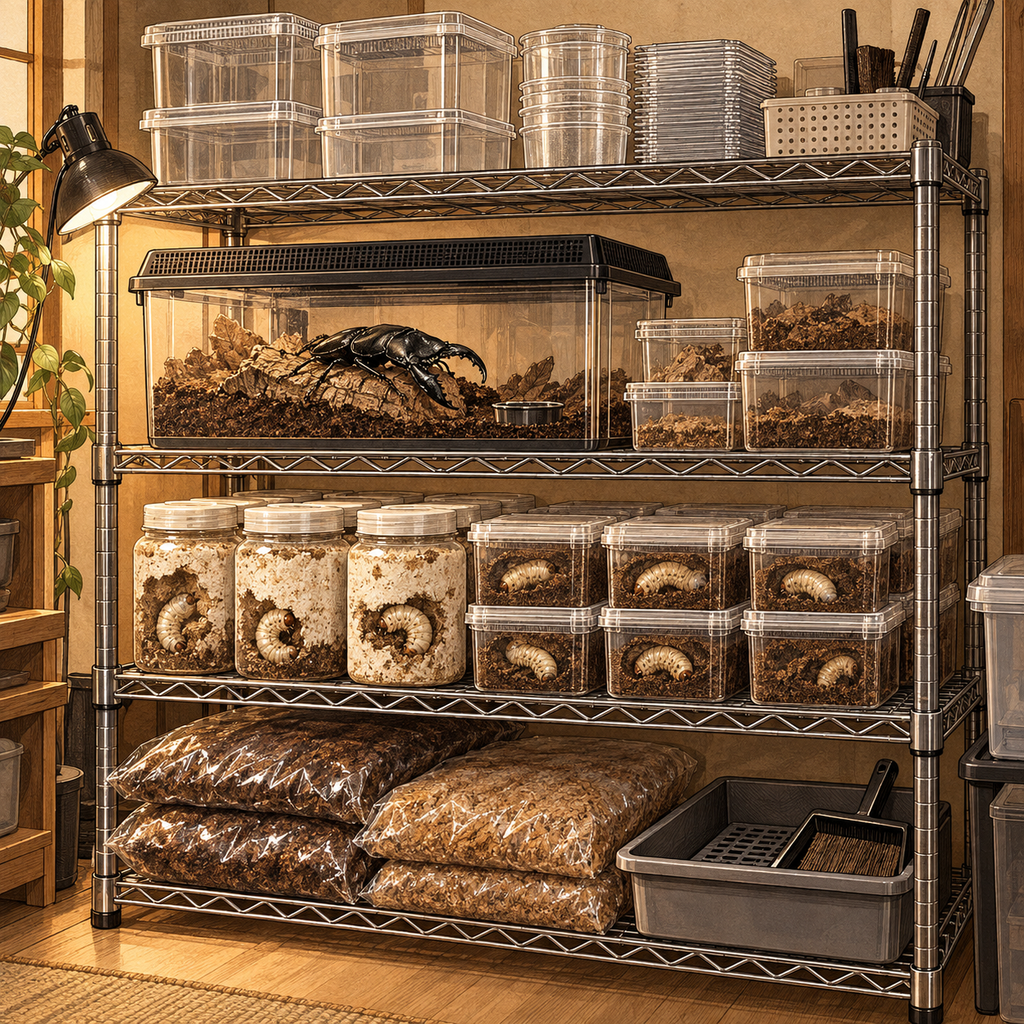
A shelf should do more than hold containers. Each level should have one clear job.
For example:
| Shelf level | Main purpose | What stays there |
|---|---|---|
| Top | Dry supplies | Empty containers, labels, paper towels, spare lids |
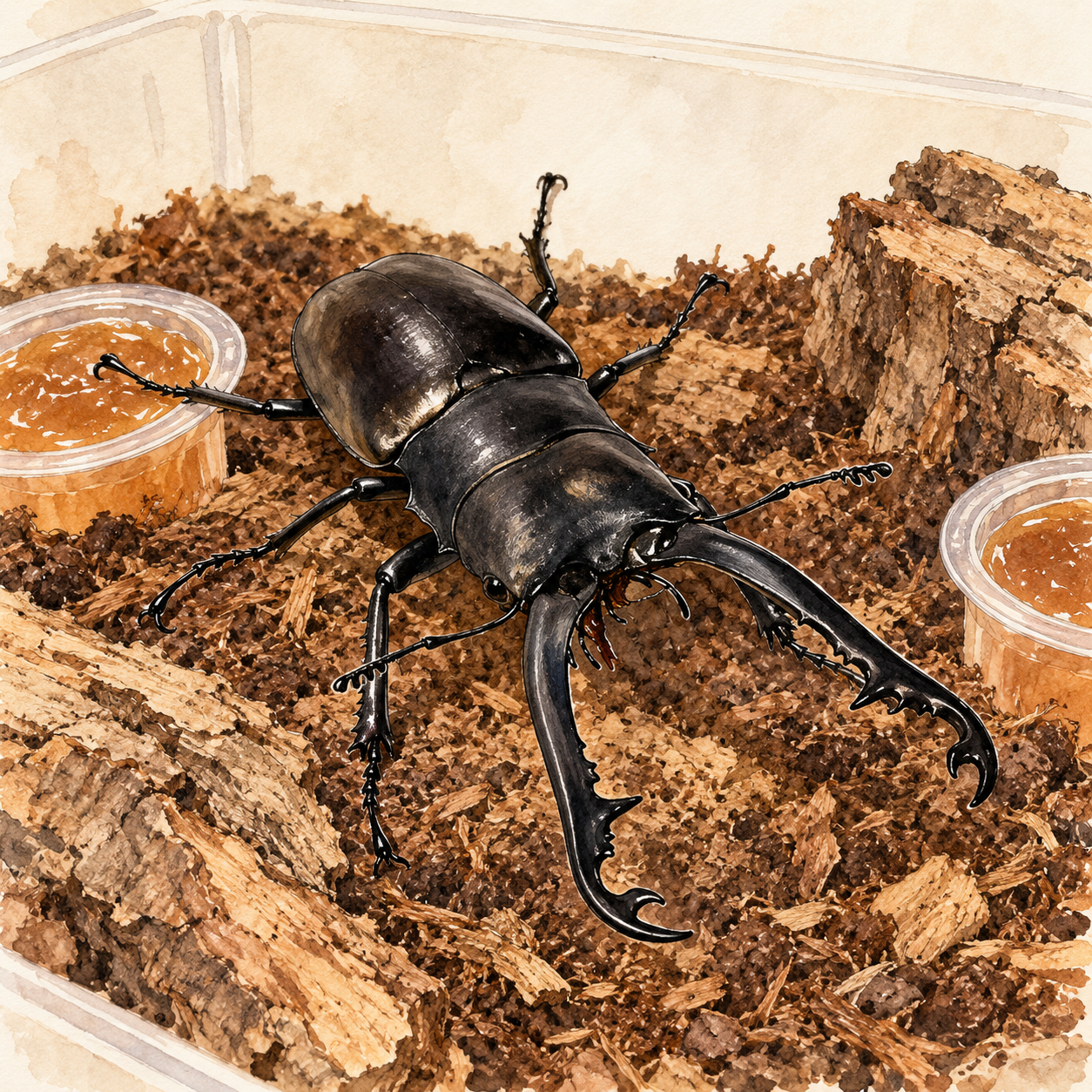
| Middle | Adult care | Adults, beetle jelly, water spray bottle, feeding tools |
| Lower middle | Active larvae | Labeled larval containers or bottles |
| Bottom | Heavy materials | Sealed substrate bags and a small cleaning tray |
Keep a little open space on every shelf. When a container needs an emergency change, you need somewhere clean to set it down. A shelf packed wall-to-wall looks efficient, but it makes routine work slower and increases the chance of mixing labels or lids.
3. Choose containers by stage, not by species name
There is no universal “best case” for every kuwagata or kabutomushi. The correct container depends on the larva’s size, feeding method, and current stage.
Small larvae
Young larvae can be kept in smaller containers while you confirm they are feeding well. Transparent containers make it easier to see moisture, frass (droppings), and mold, but do not keep them in direct light.
Growing larvae
As larvae grow, give them enough volume to feed and tunnel naturally. For species raised on fermented substrate, choose containers that are easy to open and refill without compressing the larva. For species raised in fungus-based bottles, use a bottle size appropriate to the species and growth stage.
Pre-pupal larvae
When a larva is preparing to pupate, stability matters more than easy viewing. Avoid unnecessary digging, moving, or substrate replacement. A small inspection window or a careful check of behavior is safer than opening the container repeatedly.
The principle is simple: the container should make the next care task easier, not merely fit on the shelf.
4. Build a label system that survives busy days
With ten larvae, memory can work. With fifty or one hundred, memory becomes a risk.
Every container should have a label with at least:
- species;
- sex, if known;
- hatch or acquisition date;
- current substrate or fungus bottle type;
- last substrate-change date;
- a short individual ID.
An example:
Dorcus hopei / F? / 2026-06 hatch / fermented mat / changed 2026-09-12 / DH-26-14
Use one date format throughout the collection. Put the label on the side where it can be read without lifting the container. If labels get wet or dirty, cover them with clear tape or use a waterproof marker.
The goal is not record-keeping for its own sake. Good labels answer the questions you ask most often: What is this? When was it last changed? What should I do next?
5. Track only the data that changes your decisions
Many new keepers create detailed spreadsheets and stop using them after two weeks. A useful record is short enough to update on the same day you do the work.
For each larva, track:
- ID;
- species and lineage information, if relevant;
- date of hatch or acquisition;
- substrate / bottle used;
- change dates;
- weight only when it will influence your next decision;
- unusual events, such as refusal to feed, suspected pupation, or an accident.
Do not weigh larvae just to collect numbers. Weigh them when you are comparing substrates, watching growth, or deciding whether a container is becoming too small. Handling creates stress, so the record should serve the animal—not the other way around.
6. Control temperature before chasing perfect humidity
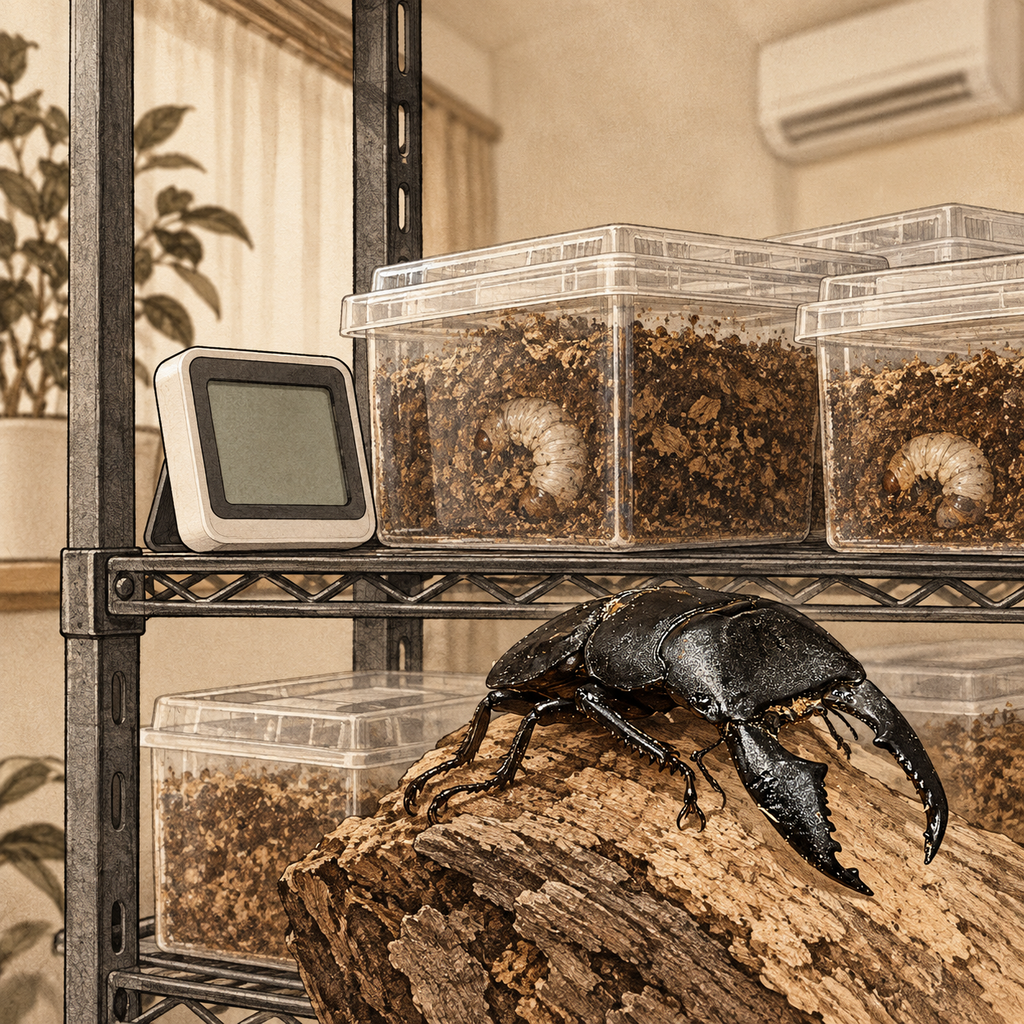
For most Japanese homes, temperature is the first major challenge. A shelf near a sunny wall, a kitchen, or an upper floor can become much warmer than the rest of the room.
Use an inexpensive thermometer-hygrometer at shelf height. Check the actual temperature where the larvae live, not only the room’s air-conditioner display.
For many commonly kept stag beetle and rhinoceros beetle larvae, a stable moderate temperature is safer than repeated swings between hot and cold. Exact targets vary by species, so research the needs of your particular beetle. In general, avoid:
- direct sunlight;
- placing containers directly beside heaters or air-conditioner outlets;
- overheating during transport or substrate changes;
- sudden seasonal temperature changes.
Small-space keepers often win by choosing the most stable part of the home: an air-conditioned room, an insulated storage area, or a shelf away from exterior walls. A large collection does not need expensive equipment first; it needs a location that stays predictable.
7. Keep substrate work clean and scheduled
Substrate changes are where most mess and mistakes happen. Set up one washable tray or plastic mat as a dedicated work area. Keep labels, spare containers, a scoop, gloves, and a trash bag nearby.
Before opening a container, prepare the replacement substrate and write the new label. Then work on one larva at a time. Never open several identical containers at once.
For fermented substrate, check for strong abnormal odor, excessive wetness, mold, compaction, and heavy accumulation of frass. For fungus bottles, follow the needs of the species and avoid disturbing healthy mycelium unnecessarily. The correct replacement timing varies widely; the best cue is the condition of the food and the larva’s stage, not a rigid calendar.
After each work session, clean spilled substrate immediately. Leftover material is an invitation for mites, flies, and confusion during the next session.
8. Prevent pests with routines, not chemicals
Fungus gnats, mites, and mold are much easier to limit early than to eliminate after they spread. The most effective routine is boring but reliable:
- keep unused substrate sealed;
- remove old beetle jelly and food cups on schedule;
- wipe shelf spills immediately;
- avoid soaking substrate until it becomes muddy;
- quarantine new insects and used equipment before adding them to the main area;
- inspect lids, ventilation holes, and shelf corners each week.
Do not spray insecticides around beetle containers. Even products marketed for household pests may be unsafe for the insects you are trying to keep. Improve cleanliness, isolation, airflow, and storage before reaching for chemical solutions.
9. Create a weekly “five-minute route”
A large collection becomes manageable when you do not need to remember what to inspect. Walk the same route every week.
- Check the shelf thermometer.
- Look for leaking containers, damaged lids, or dried substrate.
- Remove old adult food.
- Check labels and mark containers that need work.
- Record only changes that require an action.
This route is deliberately short. The deeper work—substrate changes, weighing, breeding preparation—can be planned for another day. A five-minute check prevents small issues from becoming a weekend-long rescue project.
10. Know when not to expand
The most experienced decision in beetle keeping is sometimes choosing not to keep every larva.
Before setting a new breeding pair, ask:
- Do I have enough containers for a larger-than-expected hatch?
- Can I keep the temperature stable through the next season?
- Do I have time for substrate changes at the same time as family and work commitments?
- Can I rehome surplus offspring responsibly?
Breeding success should not be measured only by egg numbers. It should be measured by whether you can provide consistent care for the larvae that hatch. A smaller, organized collection will teach you more than a large collection managed in a rush.
A small-home setup can still be serious breeding
Japanese beetle keeping proves that you do not need a warehouse to build a thoughtful breeding setup. You need an organized shelf, clear labels, stable temperature, clean substrate work, and a habit of checking small problems before they grow.
Start with a system that works for ten larvae. Once every container has a place, a label, and a next action, scaling up becomes possible. Until then, the best upgrade is not another breeding pair—it is a better routine.
At KOBE BEETLE, we share practical guides on stag beetle and rhinoceros beetle care, larval growth, breeding, and the everyday systems that make insect keeping more enjoyable.